
INFORMATIVE NEWS:
Are Safety Brakes A Legal Requirement?
In most UK installations, roller shutter safety brakes are not universally required by law, but vertically operating shutters must be designed so they cannot fall uncontrollably if a component fails. Whether a brake is needed depends on shutter weight, design, motorisation, location, and risk assessment.
Understanding Safety Brakes
Safety brakes are designed to prevent a roller shutter from falling uncontrollably in the event of a failure, such as a broken spring, gearbox fault, or drive issue. They are a critical safety feature for heavier shutters where the risk of injury or damage is significant.
It is compulsory to ensure that your roller shutters and doors comply with the Workplace Regulation 1992 Maintenance of Equipment, Devices and Systems. To comply fully with current regulations, you need to ensure that the roller shutters are inspected at least once a year.
Read more here on the DHF website.
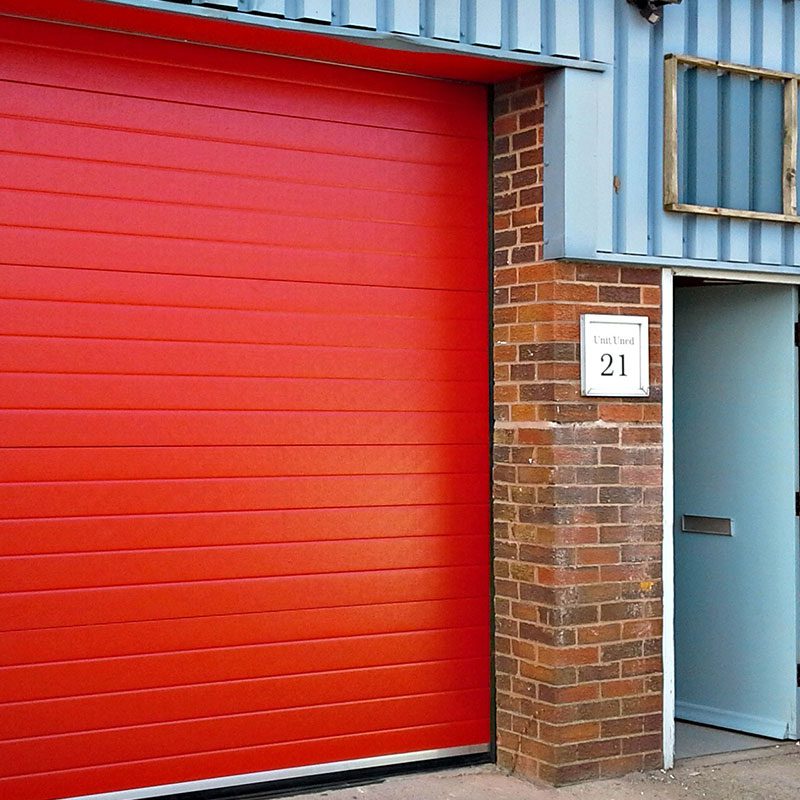
What are roller shutter safety brakes?
It’s a device fixed to the roller shutter doors that slows down or stops the motion of the shutters by applying pressure against one side of the door, its essential to provide health and safety for people and protection for your property.
This centrifugal brake arrests the descent of the shutter if there is a failure in the motor. If the motor’s operational brake fails to hold the shutter stationary when it is in its upper position, or the shutter descends at an uncontrolled speed, the safety brake will activate and bring the shutter to a complete halt.
There are many different types of safety brakes depending on the size and use of the door, each one comes with varying specifications and benefits which can be discussed to make sure you are installing the correct system.
Having this protection, you can be confident that you customers and staff will be safe.
Roller shutters have caused accidents without the implementation of safety brakes. By maintaining and servicing your shutters you will have peace of mind they are in good working order. By regular checks engineers can identify potential problems before they occur saving costly one-off repairs or breakdowns.
Installation, service, and assessments should always be by a DHF Competent trained shutter engineers. Call our team on Call 0800 0838630 or email us here to arrange a visit.


When Safety Brakes May Still Be Needed
Even if a shutter weighs less than 20kg, there are situations where a safety brake – or equivalent protection – may still be necessary:
Motorised shutters: These systems are subject to broader safety requirements, including controlled movement and obstruction detection.
High-traffic or public areas: If the shutter is installed above a doorway or walkway used frequently by people, additional safeguards may be expected.
Commercial or insured environments: Project specifications, insurers, or risk assessments may require brakes.
Poorly balanced systems: Even lightweight shutters can pose a hazard if springs or counterbalance mechanisms fail.
So What Are The Guidelines?
The reality is that no legal requirement, regulation, or standard has ever mandated the use of a safety brake or any other fallback protection device, and this remains unchanged. However, the situation is not entirely straightforward. There is a clear legal obligation to prevent a vertically operating door from falling back (guillotining shut) in the event of a failure in its hold-open mechanism.
Legislation does exist that has significantly shaped this requirement. Key examples include the GB Health and Safety at Work Act 1974, the NI Health and Safety at Work Order 1978, and the ROI Safety, Health and Welfare at Work Act 2005. Each establishes a broad duty to ensure safety in the workplace, during work activities, and in connection with work.
These laws impose criminal liability on those involved in manufacturing, installation, maintenance, and ownership or management. They are frequently relied upon in prosecutions following fall-back incidents.
In many industry guidelines, 20kg is often used as a practical threshold:
Below 20kg: The risk of serious harm from a falling shutter is considered relatively low. As a result, safety brakes are generally not mandatory.
Above 20kg: Additional safety measures, including brakes, are more likely to be required due to increased risk.
That said, this threshold is not a universal legal cutoff – it’s more of a commonly accepted benchmark used in design and risk assessment.
In Conclusion
- <20 kg + manual + low risk location → usually no brake required
- Any higher risk setup (motorised, public access, overhead hazards) → check standards / may still need one
That said, this threshold is not a universal legal cutoff, it’s more of a commonly accepted benchmark used in design and risk assessment.
The presence of reliable roller shutter brakes can significantly reduce the likelihood of accidents and injuries. In places where heavy shutters are used, an uncontrolled fall could cause serious harm to individuals nearby. A robust brake system acts as a safeguard, allowing users to operate the shutters with confidence. Therefore, investing in high-quality roller shutter brakes not only enhances security but also promotes a safer environment for everyone.
In The Know
Choosing Industrial Automatic Doors for High-Traffic Sites
INFORMATIVE NEWS: Choosing Industrial Automatic Doors for High-Traffic SitesWhen an...
Making the Decision to Choose ADC Entrance Solutions
INFORMATIVE NEWS: Making the Decision to Choose ADC Entrance SolutionsDiscover why...
How Our Minor Works Team Handles Your Repairs
INSIDE ADC ENTRANCE SOLUTIONS How Our Minor Works Team Handles Your RepairsQuick &...